Saturday, May 24, 2008
Everybody Loves a Good Malaria Story
Dear Everyone,
Greetings from Ouaga! I hope you are well.
Nomad month began on schedule. Sarah and Aili went to the Motherland, Nathan, Karissa, and Annaka went to Nasuan, and I went to Tamale for two weeks.
I stayed in the home of Missionary Ali of Tamale, Paul Her Husband, and Hannah and Baby Levi Their Children. (Hannah is probably technically a baby too, but since she speaks English, I’m giving her the benefit of the doubt.) Missionary Ali’s and my great plan for our two weeks together was to clean out her freezer of all desserts and replace them with fresh ones. Our excuse was Teacher Appreciation Week, which we had to extend into two weeks because our celebrating it in Ghana made it an international holiday instead of just an American one; this excuse was only convenient, not actually necessary, of course. Paul Her Husband’s great plan was to go on a business trip so he wouldn’t have to watch. We did a great job consuming the desserts, but our domestic prowess turned out a big fat negative: I burnt brownies, made wet, gummy wheat bread, and suffered several Chinese dumpling catastrophes including sticky glumping of the skin, dry crusty dumplings sticking together and to the plate and ripping when pulled apart, and slight burning of the pot stickers. Sigh. And Hannah’s comments weren’t exactly uplifting. Hannah eats mud off the car tires and old, sun-crusty rice from the dogs’ dish, but takes one look at even my cooking successes and cheerfully announces, “For goats!”
Missionary Ali’s birthday was observed the Saturday Sarah got back to Tamale. We celebrated with Thanksgiving dinner in the form of chicken, green beans, stuffing, and mashed potatoes. It was Paul Her Husband’s idea to maneuver two desserts, and this is how he was discovered: Shortly after I arrived in Tamale, Paul quietly mentioned Ali’s birthday and asked if I would mind making the cake. He claimed the only other person available to bake was him, and he assured me that would be a bad idea. So I agreed, and he asked that I keep it a secret. Later that week, Ali and I were making our dessert plans, and she mentioned needing to bake her own birthday cake. Well, my cake was supposed to be a surprise, so I cleverly discouraged her cake-baking plans with very unsuspicious comments about probably she didn’t need to bake a cake surely a cake will appear some other way possibly involving magic don’t worry about it. That’s when she said, “My husband says I need to bake my cake because the only other person available to bake is him.” And that’s when both of Paul’s plans were laid side by side and Ali and I decided he clearly meant to have two desserts on Saturday, which, of course, was perfectly fine with us. She made a lovely yellow cake with a coconut and brown sugar topping, and Karissa, Annaka, and Hannah helped me make strawberry shortcake. Paul showed no surprise at having two desserts on Saturday and, when confronted, marveled at the brilliance of his plan, making notes to plan similarly in the future.
Other Tamale events included Baby Levi receiving a Ghanaian name from the Peanut Lady, and Missionary Ali making him give it back a few days later when she found out it was a girl name. The Tailor of Tamale made me a dress and a skirt that are completely perfect; he measured and everything. And on Saturday, May 10, 2008, my feet were clean. And that is worthy of note.
Although I’ve not been to Nasuan since Nomad Month began, Nathan brought reports of Percy the Chicken’s transition from a house chicken to an outside chicken, which is apparently going well. Percy the Chicken seems to still prefer human company during the day, but he is content to sleep with the other chickens at night. In other chicken news, Helen the Chicken, whom Nathan brought to our chicken community only recently, was given away as food due to her illness. He didn’t really go into details, so I don’t know how a chicken can be too sick to live but not too sick to be food. Nathan broke the news to us at dinner in Tamale (not on the night we were eating chicken; this was the night before). “The new white chicken,” he began, and I asked, “Helen?” just as Karissa clarified, “Helen.” Karissa had named her, see, which is convenient for making sure everyone is on the same page. Nathan was perhaps still digesting the new white chicken’s person-name, perhaps in light of the news he had to share, and Annaka asked, “Where is Helen?” And in the lengthy pause that followed, I saw the phrase “Chicken Heaven” pass through Nathan’s mind, but he finally said, “We had to eat Helen.” Because when it comes right down to it, that’s just better theology.
This week I’m in Ouagadougou, Burkina Faso at Pretend School. My class of 2nd graders and I are spending these two weeks working on writing descriptive paragraphs. Our theme for the class is “Descriptive writing makes me feel like I’m there.” So even though you’ve never been to China, you’ll feel as if you know the place from the way I’ve described it. And even though you haven’t eaten that particular cookie, you will know the cookie from my description. In keeping with this theme, I shall now relate my experience with malaria, that reading my letter might make you feel like you have it. Generous of me, I know.
Malaria is transmitted by mosquitoes. The little malaria parasites move into the red blood cells and breed. This destroys the blood cells, and that is bad. Since I’ve had malaria, I’ve learned that, in addition to symptoms I knew about—fever, sweating, vomiting, etc.—malaria can also come with gentle symptoms such as tiredness and irritability. So when the little guys are destroying the red blood cells, the person develops anemia, which makes the person irritable. And that, friends, was probably my chief symptom: being pissed off. I cannot describe how irritated I was, at almost everybody and for very shady reasons. If you did not write to me last week, for example, I was probably annoyed at you for not being a very good friend. I’ve been trying very hard to think of anyone I was not angry with last week, and I’ve come up with one friend in Ohio and four out of five Esalas. So to the rest of you, I’m very sorry for being so angry with so little provocation. Please accept my apology and rest assured I am not angry at anyone presently. Oy.
Nathan and Sarah reckon I’d had malaria about a week or so before it was discovered. Based on my irritation, I’d say maybe just over a week. I didn’t actually feel sick, see. Just cranky. But my bad attitude didn’t seem odd to me because I hadn’t been sleeping well at night. Okay, I hadn’t been sleeping at all really. Since I began counting, I hadn’t slept five nights in a row. And that didn’t seem so odd either because Missionary Ali and I had been working so hard to consume all those fabulous desserts . . . well, when you eat chocolate cake with kool-aid less than an hour before bed, you shouldn’t wonder at your sleeping problem. Moving Evening Dessert to afternoon hadn’t quite solved the problem, but we were working on it. And I was napping well. Several hours every afternoon. The day before Sarah arrived in Tamale I had some gentle diarrhea, but I was blaming that on the egg rolls. Oh, that greasy goodness.
Sarah arrived in Tamale Saturday morning and was conscious approximately 4 hours before I was cornered and gently grilled about my health. She says her clue was my afternoon nap, which was, she maintained, not typical for me. It had become typical of me, I argued, but she scoffed. Then she learned of my diarrhea, and that sealed the deal. I overheard her, Nathan, and Missionary Ali in the kitchen discussing whether or not to seek medical care. I thought they might be talking about me, but since I wasn’t actually sick, I wasn’t sure. Aili seemed kind of moody. Maybe Aili was sick and I just didn’t know. (Actually, Aili’s ear infection was discovered a few days later, so you see how it could’ve been her, especially since I wasn’t sick.) I was surprised they decided in favor of medical care, and even more surprised to learn they were serious—as evidenced by Nathan with his shoes on and keys in hand. Oh. Okay. So I dutifully went to the clinic, a little uncomfortable since I wasn’t actually sick, but trying to be okay with the decision since clinics are easier to navigate in Tamale than in Ouaga—apparently because Tamale speaks English and Ouaga speaks French. Right.
So we went. My malaria test cost $2.00 and consisted of a poke in the finger and a little blood smear on a microscope slide. It came back positive. Okay, fine. More surprises for the day because I thought people with malaria were supposed to feel sick. Except that just knowing I had malaria made me feel lousier. More lousy. Whatever.
I didn’t sleep again that night, and the next day we packed and went to Ouagadougou. Except mostly I just sat and let Nathan and Sarah do all the packing. Because sitting down felt pretty good, but more strenuous forms of activity began to feel like work. And when I say “more strenuous forms of activity,” I mean tasks such as reading picture books to small children. Oy. I slept some in the car on the way to Ouaga; I was mostly a slug. We went through customs and I had trouble writing my passport number on the paperwork. I’m almost certain I got our license plate number wrong—only surprising because I was copying off Nathan’s paper—but the Ghanaian customs official who checked my work didn’t mention anything, and I had trouble caring.
In Ouaga, I continued my slug-like activity for the remainder of Saturday. I went to church Sunday morning but left after a couple songs to spend the whole rest of the day closed in Sarah and Nathan’s bedroom at the guest house, which may be the only room in all of Africa that is air conditioned. I was not sleeping—only lying about in a state of perpetual consciousness. Sarah says she gets brilliant ideas when she’s on malaria medication, but I apparently cannot look forward to similarly enlightened experiences. I spent the entire day contemplating the plaid on the bedspread. It was a happy plaid but not tasteful, and I wondered why the places at which blue lines crossed blue lines were darker blue but the places at which blue lines crossed red lines were darker red and not purple. And as the sun went down, I marveled that the lines that had previously seemed blue still seemed blue but that the lines that had seemed dark blue now seemed dark green.
And this was not the worst of my Cognitive Strife:
I was trying to buckle Baby Aili into her car seat so we could leave Tamale for Ouaga. Her buckle has two pieces; just fit them together and click the buckle into the slot. Standard car seat; no problem. And I’ve done it before. I had one part of the buckle in my left hand, and that was good. But I didn’t have the other part of the buckle. I determined it must be on Baby Aili’s other side, and getting it would be just the thing to do. So I reached my right hand down between Aili and the side of the seat, which was not far away but which was out of my line of sight. I was aware of my hand, but I couldn’t see it. I sat thus for quite some time; I was problem-solving. I needed to get the buckle. It might’ve been in my hand. Or, it could’ve been roughly two inches to the left of my hand. But since I couldn’t see it, I didn’t know. With a great deal of effort, I could’ve pulled my hand up to see if indeed I had the buckle. But then what if I didn’t in fact have it? Or, I could’ve moved my hand two inches to find the buckle there. But what if the buckle wasn’t there? What if I was already holding the buckle? Then I would’ve dropped the buckle, see, and moved my hand away from it, and that’s no good. Because I really needed the buckle. If only I knew whether or not the buckle was truly in my hand. But I didn’t know. I felt what was in my hand, but I still didn’t know if I had the buckle—or if I even held anything. I ran through my options again. And again. Still no good; same problems as before. After several problem-solving moments—and I’m not kidding; this was a cognitive exercise—I hit on a workable solution. I realized I was sitting right next to Aili and Annaka. So I explained to them that I needed the other part of the buckle, and I asked them to please get it for me. This worked like a charm. Someone handed me the buckle from wherever it had been, and I fastened Aili’s car seat.
Not as desperate but still a struggle was the problem I faced in reaching my water bottle later that day. By this time, we were in Ouaga. I was in my room lying down, and my water bottle was about two yards away on the desk. The light was on too, and that was bothering me. So I very carefully crafted a plan, which had four parts: 1. Get up. 2. Turn off light. 3. Pick up water bottle. 4. Lie back down. I was proud of the plan; it seemed good. I put it into action, working very hard, and then . . . I felt that something wasn’t right. I’d turned off the light. I’d gotten back in bed. But I didn’t have water. After some minutes, I pinpointed the problem: I had skipped Step 3 of The Plan. Disappointed but not discouraged, I identified my need for a New Plan. Wishing to maintain this forward momentum, I was thinking very hard about what this New Plan might entail, and I was very hopeful, when Sarah showed up. Well. I asked her to reach my water bottle, and she, of course, did, with an amused “been there” sort of expression on her face. But I think I would’ve gotten that water very soon even if she hadn’t shown up. Because with the water I still had ideas. It wasn’t like with the car seat buckle.
On Monday I improved from lying around to sitting around. Pretend school began, and Nathan taught my class. This is only right and proper since my illness was all Nathan’s fault: I didn’t feel sick at all until he dragged me to the clinic. But that’s just another ever-present feature of life with the Esalas: They are solving my problems before I even realize I need something.
I’m doing much better now. I’ve finished my malaria medication, and I’m eating lots of iron to help my red blood cells along. “Pig out on meat,” was, I believe, Sarah’s phrase.
And now, What I’ve Learned:
1. I hesitate to put this one at the end of the malaria email, but at least this way you won’t accuse me of tricking you into an uninformed decision: Lots of missionaries want teachers to come and help them educate their children, but not many teachers are here. If you or someone you know are interested in investigating teaching options in Ghana, please let me know. Missionary Ali, for example, has two great friends named Dan and Di. They are Ghanaian and Canadian, respectively, and are married to each other. Their daughters are 10 and 11 and are currently at boarding school. They live in Tamale, so their teacher would enjoy many luxuries of city living, such as grocery stores, television, and church services in English, plus many other missionary-type service opportunities as desired in addition to teaching. Their teacher will also enjoy living just 3 hours away from me. I can’t think of anything more enticing than that, so I will end the commercial now. (But it will reoccur in the Prayer Requests section.)
2. We eat dinner before dark so we don’t accidentally eat bugs. I cooked and served dinner after dark when I stayed home with Hannah and Baby Levi while Missionary Ali and Paul Her Husband went out to dinner. I spent the whole meal picking bugs out of the pancake batter, off of my plate, out from between the tines in my fork, and out of Hannah’s mouth. Disgusting.
3. I can carry babies on my back. I can’t actually put them up there by myself, but if someone else positions the baby and then acts as a spotter while I tie, I’m not that bad. Missionary Ali let me practice on her kids, so I carried Baby Levi while I swept the floor and Hannah when we all walked down the road to have tea with Paul Ali’s Husband. Sometimes Baby Levi needs a little pep talk before he gets tied back there, but once I reminded him how everyone would know he was foreign if he screamed like that, he did pretty okay.
4. Conga lines are standard offering-collection policy at church. I went to the Presbyterian church with Missionary Ali. Her church is bigger than my Nasuan church. They speak English, they sing hymns I know, and the men and women aren’t segregated. But they still have a conga line at offering time.
5. Also at Missionary Ali’s Presbyterian church, I learned that organ music isn’t as bad as I thought it was. Previously, I held the opinion that the organ sounds basically like a small herd of dying cows. But now I know that organ music just needs accompanied by really loud drums. Then it’s pretty good.
6. Malaria is a grand weight-loss plan. Remember the perfect skirt the Tailor of Tamale made for me—the one that fits so great because he measured me? Well. It fit much better last week than it does now. But no worries. I bought a lot of chocolate at the grocery store today, and I will have that skirt fitting again in no time.
And now, Prayer Requests
1. Missionary Ali’s friends, Dan and Di, need a teacher for their daughters. Please pray for a willing someone who will fit in well with their family.
2. My malaria-induced anemia, and iron absorption to build red blood cells. Praise God that Esalas recognize malaria when they see it and can seek proper treatment.
3. And we’re still in the throes of Nomad Month. We’ll be traveling from Ouaga to Accra next week and back to Nasuan the following week, concluding approximately 6 weeks of travel. Oy.
Thanks for your prayers, letters, and friendship.
Christina
Quote of Today
“It doesn’t count as multitasking if you forget the task you started first.”
Missionary Ali, on another kitchen disaster
Saturday, May 24, 2008

Tuesday, May 20, 2008
Women’s Work
Sunday, April 27, 2008
Women’s Work
Dear Everyone,
Greetings! I hope you are well.
After a lovely supper of stew, bread, and Melfloquine (for malaria prevention), with chocolate icing for dessert, I’m settling back to watch the termites swarming my overhead light while I write to you. I’m also watching a worm crawl across my rug (it’s a plastic rug, so this isn’t actually that gross). He’s a strange worm with antennae and a body that’s hard, rather than squishy. I think he may have crawled in here and died. The ants are investigating. I’m pulling my feet up into my chair.
With the rain a few days ago and again last night, the bugs are rather more prevalent than they’ve been. Fortunately, with the increase in bugs I’ve also noticed an increase in my house lizards. House lizards are my great blessing. I’ve named them all Thomas.
The rain also means farming time. And farming time means reduced church attendance.
Our church is a one-room building made from mud. We’re Lutheran; other denominational options include Roman Catholic and Assemblies of God. The men sit on the left on rickety wooden benches and the women sit on the right, children in the front. The worship team consists of a few guys with drums and a song leader. We have real live church mice who scurry in the rafters behind the preacher’s head. Sometimes I watch them if the sermon is long and not in English. So that’s pretty much every time. The specifics of the worship service are pretty standard except for collecting the offering, which is basically a conga line. The music is loud and the men go first, singing and clapping as they file out of their rows and snake up to the collection plate, drop their money in, and conga back to their seats. The women fall in at the end of the men’s line.
Church starts when the people arrive. We know it’s time to go to church when we hear the drums calling the people to worship, except that we live so far from the church we almost never hear them. So for us, getting to church on time is sort of like practice for the Second Coming. We know the day, sure; but no one knows the hour. So be ready because church will begin like a thief in the night. Today the Esala womenfold and I heard the drums and were the first ones at church (Nathan was taking a woman from the village to the hospital). We read a Bible story together, but then the babies needed naps so we went back home. Church started later, but we missed it.
I’ve written so much about “man work” that I become concerned it seems my definition of “man work” is “any work that is exciting.” But this is not the case. This week, I participated in the Women’s Work to End All Women’s Work, which, of course, was pounding gravelly dirt into floor. And what’s not exciting about that? Friends, everything is exciting about that.
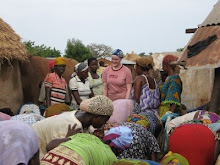
Houses in the village are comprised of several round, single-room huts arranged in a circle. The huts are connected by a circular wall made of the same mud as the huts to form an open-air courtyard. Functionally, the huts serve as bedrooms for the most part (I think), and the courtyard acts as living room and kitchen. One of the houses (we also call them “compounds”) in the village needed a new floor in the courtyard, so all the women in the village came to pound the floor. It’s a community event—sort of like a barn raising. Each woman has her own floor-pounding tool—a wooden mallet, half a cylinder with a perpendicular, stick-like handle protruding from one end. They grip the pounder by the handle and smack it on the ground like a foot, standing bent 90 degrees at the waist with straight legs and shuffling back and forth over the yard in a great cluster of rows, like a sea of backs and colorful headscarves. They sing and keep in rhythm, sometimes staying always bent over in a quick tempo, pounding on the beat, and sometimes raising up with the pounders high above their heads and bringing them down for a slower beat.
I say “they,” but I mean “we” because I, as a woman in the village, got to play too. Since I’m new, I didn’t have a pounder, of course, but Sarah is not new. She loaned me her pounder because, as she told those around us who were surprised she had one, “If you do not have the tool, then you cannot have the opportunity.” When we arrived at the compound, I was immediately sent home to change my clothes. I’d missed the memo about this work being grubby; I am a rookie. When I arrived for the second time, I was handed over to a teacher to “just follow her.” So I did. In my culture, we bend our knees when we bend over, so keeping my legs straight and folding myself in half was a challenge. Actually, the whole experience was a bit of a cognitive overload. I stepped along with my teacher. Forward. Forward. Don’t pound your feet; don’t pound your face. Forward. Forward. Don’t pound your neighbor’s feet; don’t pound your neighbors face. Backward. Backward. Keep your legs straight; don’t pound your face. Backward. Backward. Keep the rhythm; don’t make divots. Backward. Backward. Keep backing up even though there’s a wall there. Backward. Backward. Wedged behind a hut; don’t pound your neighbor’s face. Forward. Forward.
The whole thing took so much concentration I didn’t notice the huge blister that had formed—and then popped and begun oozing—on my hand until I stopped pounding, at which point it began to hurt rather a lot. Fortunately the floor was mostly finished by that time, and people paused for a little break. Ordinarily, I’m told, this is the part where the pito comes out, but the family of the compound were Muslim (which apparently means no alcohol), so we drank a thin, white, sour liquid instead. On the way home, I learned the mud I’d been pounding was actually a mixture of dirt, a plant product called doua-doua (say “DOW-uh DOW-uh”), and poop. And that’s women’s work.
This week’s mouse count is one small baby, who I accidentally trapped under a book while he squeaked at me. I was going to bash it myself but wussed out and asked Nathan to do it.
Asala the House Girl is feeling better; thanks for praying for her. Falling Star the Chicken (the one hatched on top of the refrigerator) was fatally stepped on the other day, so if you wanted to pray for Karissa’s emotional well-being (since she allegedly did the stepping), that would be appropriate.
Looks like the worm is alive after all. He’s on the move again.
Christina
Subscribe to:
Posts (Atom)